Why are there SO many microphones to choose from?
I went to the store to buy some baking powder. We were out of baking powder. How did that happen? What is baking powder? Nobody actually knows and nobody knows what baking powder does, but ours went away. It was gone… and we needed more to , uh, I guess bake something. I guess that is what baking powder does. It bakes things.
So, I walked down the aisle at the grocery store to find not one, but seven kinds of baking powder. Unfortunately, I had no blog access to get my learning on, so I picked the coolest looking package (and the most expensive… $5) and went on my way.
That is the same way a lot of people choose microphones.
There may be no real reason for seven brands of baking powder, but the microphone differences are not subtle. They are huge and important. And most of us know what microphones do.
So, picking one is not as simple as getting the most popular mic and calling it a day. YES, the popular mics are popular for a reason. We can substitute the word ORDINARY for POPULAR. If you are looking for Ordinary performance, stop reading.
The technology and design used in most microphones was developed in the 1950’s. Some are almost identical to the original designs. In the 1950’s, we did not have DSP, fancy mixers, powered speakers, and the amazing sounding gear we have now. The mic was designed to work with crummy stuff. Well, the stuff is no longer crummy. Many very innovative mics have come to market. The use of exotic rare earth magnets, fancy condenser elements, and crazy housing materials have afforded us all kinds of innovation… but the buying public keeps demanding ordinary. So the fancy better mics come and go, hitting the mediocrity wall as hard as they can… but not breaking through.
If you want to take a teaspoon of risk (continuation of baking powder metaphor) you can get a mic that really is amazing for less money than ordinary mics.
So, why so many?
Here are a few reasons, but not all:
Polar Pattern. We want to let the good sound in and keep the bad sound out of our mics. Where is the good sound? It is in your mouth-hole. Where is the bad sound? It might be right in front of you (your monitor) or off to the sides. Mics reject from either the front, the sides, or they don’t reject at all (omni). Pick the pattern that works for your stage.
Condenser or Dynamic. A little more complicated. Condenser mics usually sound better, but they can make popping sounds when you unplug them and often don’t have a switch. They also are maybe less rugged and don’t like the rain (secret code for spit). Dynamic mics are rugged and work the same every time. They don’t pop when you unplug them, and they don’t need batteries or “phantom power”.
So if we just look at those two things…if a shop carries two brands of mics, two types of patterns, and two types of mics… that is 8 mics in the fancy case (that prevents you from buying them). If you have 3 brands, then, uh, it is like 100 mics or something. You get the idea.
Listen to your mic from the side, from the back, and see if it rejects the way you want. Make sure you sound like you when plugged into a PA.
Unlike baking powder, mics do things. Good things. Don’t settle for ordinary. Listen to some mics and get the very best one you can afford. Nobody ever said “I wish I had a crummier mic.” Nobody also said, “This baking powder SUCKS”.
RESOURCE
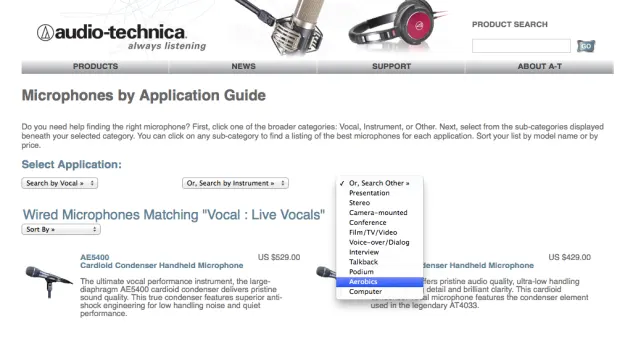
Check out Audio-Technica’s Microphones by Application Guide